
脳疾患モデュレーション研究グループ
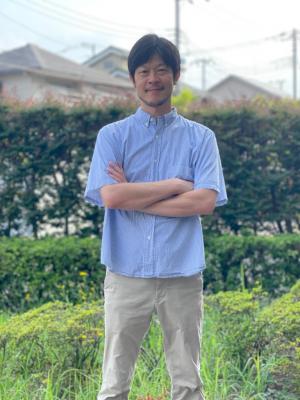
グループリーダー 下條 雅文
脳疾患発症メカニズムの解明とその克服を目指した基礎研究
研究内容
脳疾患発症メカニズム解明とその克服を目指した基礎研究
精神神経疾患モデル動物の脳病態を生体イメージングにより可視化し、分子生物学や生化学、組織学、神経生理学、行動学など多様な解析方法と組み合わせながら疾患発症メカニズムの解明を目指します。また、遺伝子工学を駆使してよりヒト疾患に近いモデルを開発・評価するとともに、病態の早期診断や予防・治療につながる技術開発を通じて、ヒト臨床研究につながる脳機能の評価法確立と治療シーズの創出を目指します。
生体イメージングを基軸とした認知症モデルマウス病態の解明
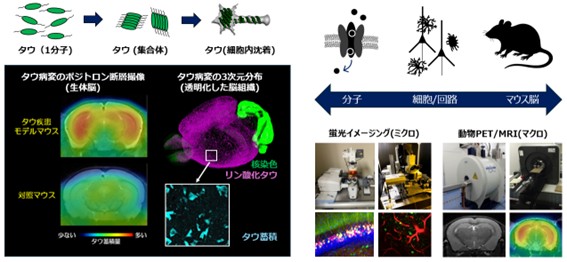
タウ疾患モデルマウス脳におけるタウ病変のPET画像と透明化した全脳組織におけるリン酸化タウ蓄積の3次元分布。対照マウスでは脳内の薬剤集積量はわずかだが、タウ疾患モデルマウスでは大脳皮質や海馬において強い集積が認められます。多様なイメージング手法を駆使し、タウ疾患モデルマウス脳の病態ダイナミクスをミクロからマクロまでマルチスケールに画像解析して解明を目指します。
ヒト臨床研究につながる脳機能の評価法確立と治療シーズ創出
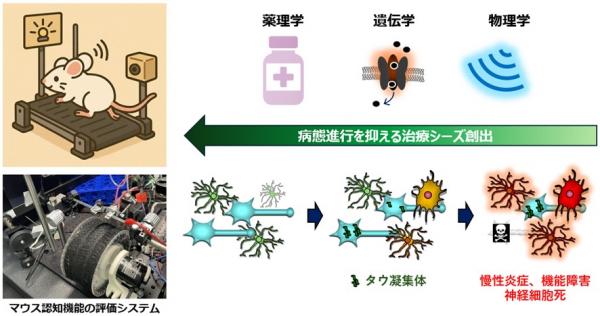
認知症モデルマウスで脳活動と認知行動を同時に評価する研究プラットフォームを構築し、脳回路が障害されるメカニズムの探索や新しい治療薬剤による病態改善効果を評価します。薬理学、遺伝学、物理学などを駆使して、病態進行を抑える治療シーズ創出を目指します。
メンバー
| グループリーダー | 下條 雅文 |
|---|---|
| 主幹研究員 | 廣川 純也 |
| 研究員 | 中園 智晶 / 松下 有美 / 矢内 凜 |
| 博士研究員 | 遠藤 雅瑛 / 小池 力 |
| 主任技術員 | 南久松 丈晴 |
| 技術員 | 佐々木 沙由里 / 林 清華 |
| 連携大学院生・リサーチアシスタント | Agu Anne Bernadette Salbador / 井上 竜斗 |
| 実習生 | 野村 佑生子 |
主要論文
- Sampei K., et al. "Pharmacological potentiation of Nav1.1 channels in interneurons mitigates tau depositions." bioRxiv (2025)
- Matsushita Y., et al. "TRPC6 is a mechanosensitive channel essential for ultrasound neuromodulation in mammalian brain." PNAS, 121(50): e2404877121 (2024)
- Yanai R., et al. "A novel tauopathy model mimicking molecular and spatial aspects of human tau pathology." Brain Communications, 6(5): fcae326 (2024)
- Kudo T., et al. "Selective dysfunction of fast-spiking inhibitory interneurons and disruption of perineuronal nets in a tauopathy mouse model." iScience, 26(4): 106342 (2023)
- Kimura T., et al. "A quantitative in vivo imaging platform for tracking pathological tau depositions." European Journal of Nuclear Medicine and Molecular Imaging, 49(13): 4298–4311 (2022)
- Shimojo M., et al. "A genetically targeted reporter for PET imaging of deep neuronal circuits in mammalian brains." EMBO Journal, 40(22): e107757 (2021)
- Maeda J., et al. "Distinct microglial response against Alzheimer's amyloid and tau pathologies." Brain Communications, 3(1): fcab011 (2021)
- Osako Y., et al. "Contribution of non-sensory neurons in visual cortical areas." Current Biology, 31(13): 2757–2769 (2021)
- Shimojo M., et al. "Selective Disruption of Inhibitory Synapses Leading to Neuronal Hyperexcitability." Journal of Neuroscience, 40(17): 3491–3501 (2020)