

Tomoyuki FURUYASHIKI
Professor, Department of Pharmacology, Graduate School of Medical and Dental Sciences, Institute of Science Tokyo
Link to the laboratory website
Expertise
Neuroscience, Pharmacology
Research outline
I am leading the collaborative subproject under Moonshot Goal 7, “Brain Senoinflammation,” entitled “Elucidation of brain-periphery interactions and functional/structural remodeling of neural circuits in senoinflammation pathology underlying depression and dementia, and application to drug development.”
Aging contributes to the onset and progression of depression and cognitive impairment and increases the risk of a wide range of brain disorders, including dementia. However, many aspects of the underlying mechanisms at the molecular, cellular, and neural-circuit levels remain unclear. In the past studies, we demonstrated that chronic stress triggers brain and peripheral inflammation initiated by microglia and bone marrow-derived cells, leading to functional and morphological reorganization of neural circuits, which in turn results in depression and cognitive impairment. Because aging is known to increase inflammatory molecules and cellular senescence markers in the brain and peripheral tissues, “senoinflammation,” a state in which cellular senescence and inflammation mutually amplify each other, may also contribute to depression and cognitive impairment associated with aging and dementia. Nonetheless, its roles remain poorly understood.
In this study, using aged mice and dementia model mice, we will combine cutting-edge approaches, such as multidimensional behavioral analysis, single-cell multi-omics, and whole-brain imaging to comprehensively elucidate dementia-specific, aging-induced senoinflammation pathology involved in depression and cognitive impairment at molecular, cellular, and neural-circuit levels. Furthermore, based on the mechanisms identified, we aim to establish a technological foundation that will enable biomarker discovery and drug discovery for the prevention and treatment of dementia.
Main Research Focus
Elucidation, visualization, and control of aging-induced senoinflammation pathology in dementia
In dementia and other neurodegenerative diseases, aging is a major risk factor. However, many widely used dementia model mice are designed, largely for experimental convenience, to exhibit phenotypes even at a relatively young age. As a result, the role that aging plays in the onset and progression of dementia has not been clarified.
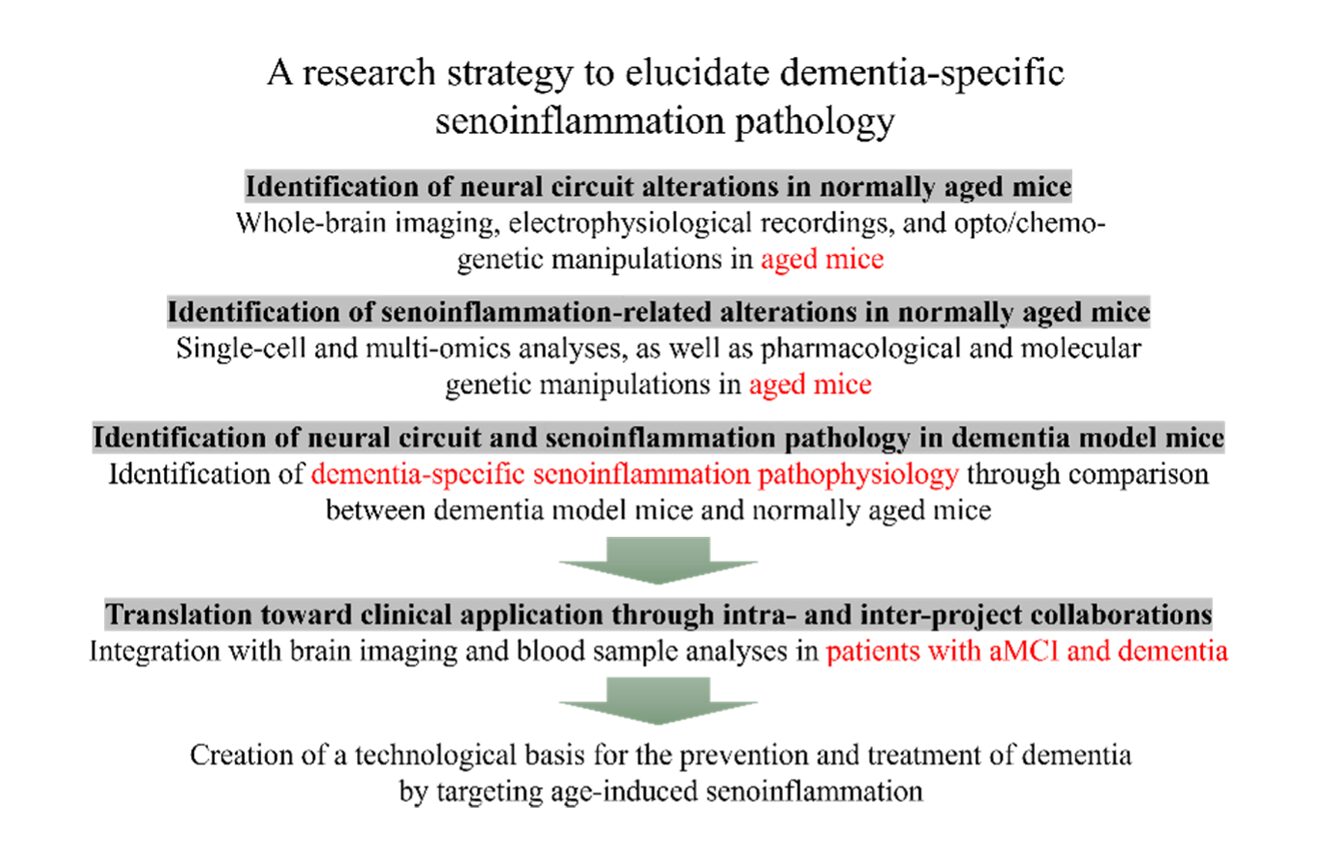
In this project, we first aim to elucidate age-related changes in brain function (normal aging) and to elucidate their molecular, cellular, and neural circuit mechanisms. We have established a multidimensional behavioral analysis platform that enables comprehensive assessment of cognitive impairment, reduced motivation, decreased social behavior, and increased anxiety-like behavior observed in aged mice. Furthermore, we have found that distinct neural circuits are involved in different behavioral changes, and that genetic background influences how age-related behavioral alterations manifest.
Building on these foundations, we will identify brain regions involved in aging-related behavioral changes using whole-brain imaging and analyze abnormalities in neural activity and neural projections in the identified regions using electrophysiological and histological approaches. Senoinflammation-related alterations in these brain regions will then be comprehensively evaluated using single-cell multi-omics and spatial transcriptomics analyses. Subsequently, the roles of altered neural circuits and molecules will be validated using optogenetic, chemogenetic, and molecular genetic methods. We will also analyze changes in peripheral blood cells and clarify their interactions with senoinflammation-related alterations in the brain, thereby elucidating brain-periphery crosstalk. In addition, by focusing on differences in genetic background, we will investigate genomic factors that influence individual variability in aging-related behavioral changes.
In parallel, similar analyses will be conducted in dementia model mice carrying amyloid-β or tau mutations, allowing us to clearly distinguish between normal brain aging and aging-induced pathologies specific to dementia. Through this approach, we aim to extract senoinflammatory pathologies that are uniquely associated with dementia. Furthermore, through collaborative research within and beyond the project, we will conduct brain imaging and blood sample analyses in individuals with mild cognitive impairment and dementia, thereby extending our findings toward visualization and manipulation technologies targeting these pathologies.
Through this research, we aim to deepen our understanding of the pathophysiology of dementia and its associated neuropsychiatric symptoms, and ultimately to establish a technological foundation that will contribute to future preventive and therapeutic interventions.
A review article summarizing the research content
Furuyashiki T. Kitaoka S. Neural mechanisms underlying adaptive and maladaptive consequences of stress: Roles of dopaminergic and inflammatory responses. Psychiatry and Clinical Neurosciences 73, 669–675, 2019. doi: 10.1111/pcn.12901
Selected publications
Okuda Y. Li D. Maruyama Y. Sonobe H. Mano T. Tainaka K. Shinohara R. Furuyashiki T. The activation of the piriform cortex–lateral septum pathway during chronic social defeat stress is crucial for the induction of behavioral disturbances in mice. Neuropsychopharmacology 50, 828–840, 2025. doi: 10.1038/s41386-024-02034-7
Kitaoka S. Tomohiro A. Ukeshima S. Liu K. Wake H. Kimura S.H. Yamamoto Y. Nishibori M. Furuyashiki T. Repeated social defeat stress induces HMGB1 nuclear export in prefrontal neurons, leading to social avoidance in mice. Cells 12, 1789, 2023. doi: 10.3390/cells12131789
Ishikawa Y. Kitaoka S. Kawano Y. Ishii S. Suzuki T. Wakahashi K. Kato T. Katayama Y. Furuyashiki T. Repeated social defeat stress induces neutrophil mobilization in mice: Maintenance after cessation of stress and strain-dependent differences in response. British Journal of Pharmacology 178, 827–844, 2021. doi: 10.1111/bph.15203
Nie X. Kitaoka S. Tanaka K. Segi-Nishida E. Imoto Y. Ogawa A. Nakano F. Tomohiro A. Nakayama K. Taniguchi M. Mimori-Kiyosue Y. Kakizuka A. Narumiya S. Furuyashiki T. The innate immune receptors TLR2/4 mediate repeated social defeat stress–induced social avoidance through prefrontal microglial activation. Neuron 99, 464–479.e7, 2018. doi: 10.1016/j.neuron.2018.06.035
Shinohara R. Taniguchi M. Ehrlich A.T. Yokogawa K. Deguchi Y. Cherasse Y. Lazarus M. Urade Y. Ogawa A. Kitaoka S. Sawa A. Narumiya S. Furuyashiki T. Dopamine D1 receptor subtype mediates acute stress–induced dendritic growth in excitatory neurons of the medial prefrontal cortex and contributes to suppression of stress susceptibility in mice. Molecular Psychiatry 23, 1717–1730, 2018. doi: 10.1038/mp.2017.177